
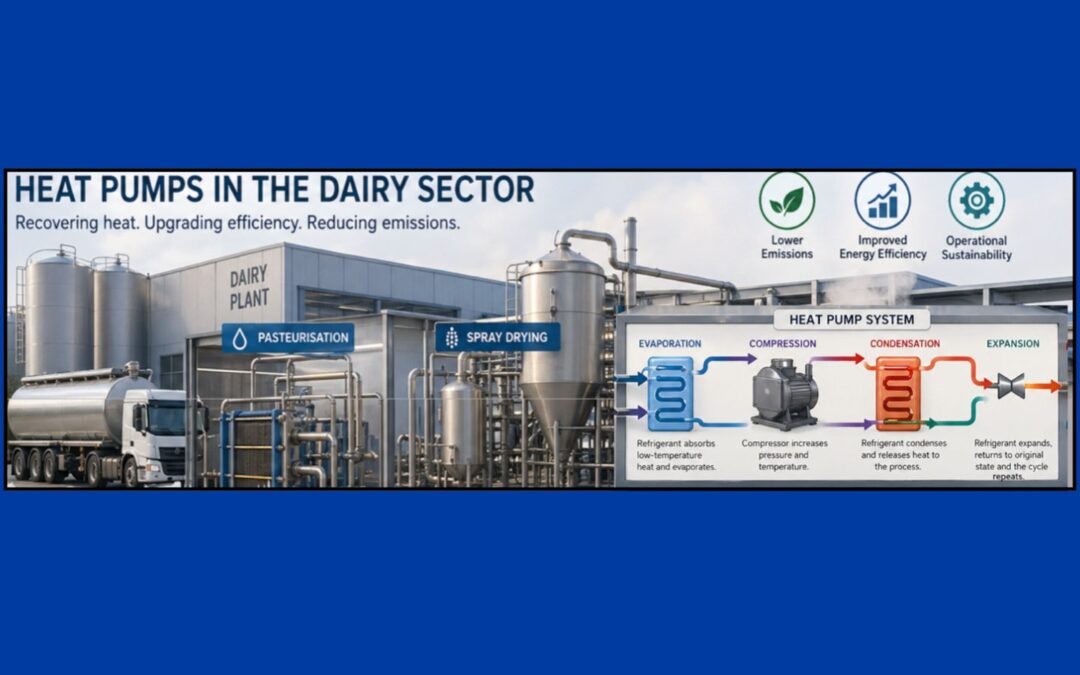
Decarbonising industrial heat is a key challenge in reducing greenhouse gas emissions. Fossil fuel systems, such as natural gas boilers, have traditionally been used in many industrial processes that require continuous high-temperature heat. In the European Union, reducing industrial emissions is a crucial component of the objective to achieve climate neutrality by 2050. Source: European Commission 2050 long-term strategy. Available here: link. The dairy industry provides a clear example of this challenge. Key operations such as pasteurisation, spray drying, and steam generation require substantial thermal energy. At the same time, dairy plants operate extensive cooling systems, creating significant flows of low-temperature heat that are often not reused. Heat pumps offer a way to capture this heat and convert it to useful process temperatures. Recent industrial applications show how this approach is being implemented in practice.
Heat pumps operate through a thermodynamic cycle consisting of evaporation, compression, condensation and expansion. A refrigerant absorbs heat and evaporates into vapour. A compressor increases the pressure and temperature of the refrigerant. The refrigerant then condenses into liquid form, releasing usable heat to the process. Through expansion, the refrigerant returns to its original state, and the cycle repeats. This cycle allows heat pumps to recover heat from low-temperature sources and upgrade it to higher temperatures. According to the system description provided by Tetra Pak, heat can be recovered from sources such as tower water and reused within production processes. Heat pumps can also generate ice water for cooling and heat simultaneously.
One example of this application is pasteurisation, an essential process for ensuring product safety and extending shelf life in dairy production. Conventional systems rely on fossil fuels to generate heat and electrical chillers to cool products. Tetra Pak developed an integrated heat pump system designed to reuse and upgrade excess heat within the pasteurisation process while simultaneously generating heating and cooling. This reduces the energy inputs required for pasteurisation. Tetra Pak provides example figures for a typical dairy production line that produces 60,000 litres of milk per hour and operates 6,000 hours per year. In this scenario, energy consumption for pasteurisation could be reduced by up to 77%. This corresponds to operational savings of up to €260,000 per year and CO₂ emission reductions of up to 650 tonnes annually. Source: Tetra Pak. Integrated Heat Pump System. Available here: link.
Another energy-intensive process in dairy production is spray drying, a central step in milk powder production. Traditionally, the thermal energy used in spray dryers comes from the combustion of fossil fuels such as natural gas. A European dairy processing company installed an integrated high-temperature heat pump system developed by GEA, known as AddCool. The system was introduced to reduce energy consumption and CO₂ emissions while maintaining operational efficiency and product quality. Following an energy audit, the AddCool heat pump was retrofitted into the existing spray drying system. It captures waste heat from the cooling process and reuses it to reduce the natural gas required for heating the primary air in the dryer. The system provides both heating and cooling and was integrated into the existing process. According to the case description, the installation reduced CO₂ emissions from the spray drying process by around 59%, corresponding to approximately 1,300 tonnes annually. Natural gas consumption was reduced by an estimated 610,000 Nm³ per year. The system also reduced electricity consumption on the existing chiller system and includes a six-year guarantee on heat pump performance. Source: Data Bridge Market Research. Installation of an integrated high-temperature heat pump system in dairy spray drying. Available here: link.
Heat pumps can also be applied to steam generation in industrial processes. A demonstration project at Royal FrieslandCampina’s Maasdam dairy in the Netherlands illustrates this application. In this installation, a HighLift heat pump supplied by Olvondo replaced an existing natural gas boiler used for base-load steam production. The system produces steam at 4 barg and was installed as part of a factory upgrade project. The installation is reported to reduce energy usage by 48% and CO₂-equivalent emissions by 88%, with estimated annual CO₂ savings of approximately 1,300 tonnes. The HighLift heat pump uses helium (R-704) as the working fluid and piston compressor technology. The investment cost for one HighLift heat pump is reported as €800,000, excluding integration costs. The case documentation notes that the supplier provided the information, which may vary depending on application parameters. Source: Heat Pumping Technologies. Industrial High-Temperature Heat Pumps: Royal FrieslandCampina demonstration project. Available here: link.
These examples show that heat recovery technologies can be applied at different stages of dairy processing. By recovering and upgrading heat within existing production processes, heat pumps offer a way to improve energy efficiency and reduce emissions in industrial operations. Documenting such applications helps demonstrate that these technologies are already being deployed in practice. Projects such as BETTED contribute by analysing and sharing examples of technologies used to improve energy efficiency in industrial processes of the dairy sector. Raising awareness of practical applications can help inform stakeholders about technologies that support more energy-efficient industrial processes.
AUTHORS: Giulia Baldelli; Natalia Athanasopoulou and Kartik Veerakumar.