
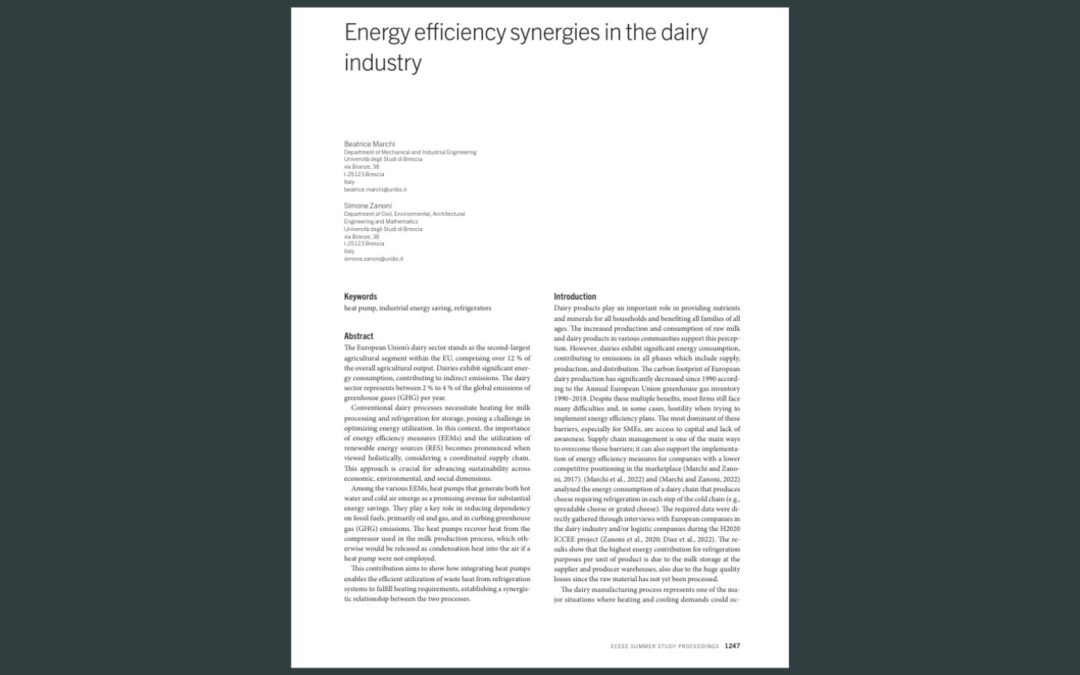
The BETTED project is pleased to feature the peer-reviewed paper “Energy Efficiency Synergies in the Dairy Industry”, authored by researchers from the University of Brescia (UNIBS), Italy and presented under Panel 9: Energy Efficiency and Sustainability of Industry at the Zero Carbon Industry Event in Rome.
The publication addresses one of the key challenges facing the European dairy sector: reducing energy consumption and greenhouse gas emissions while maintaining competitiveness and productivity. As the second-largest agricultural sector in the European Union, accounting for more than 12% of total agricultural output, dairy production relies on energy-intensive processes that contribute significantly to indirect emissions.
The paper highlights how improving energy efficiency and increasing the use of renewable energy sources can support the sector’s transition towards greater sustainability. Rather than focusing on individual technologies in isolation, the authors advocate for a holistic approach that considers coordinated actions across the dairy value chain, generating benefits from economic, environmental, and social perspectives.
A central focus of the study is the role of heat pumps capable of simultaneously producing hot water and cooling. These systems recover heat generated during refrigeration processes and repurpose it for heating applications, creating valuable synergies between two essential dairy operations. By utilizing heat that would otherwise be wasted, heat pumps can significantly reduce energy consumption, decrease dependence on fossil fuels such as oil and natural gas, and lower greenhouse gas emissions.
The paper demonstrates how integrating heating and cooling systems through heat pump technology can improve overall energy performance in dairy facilities while supporting decarbonisation objectives. In addition, the authors present the concept of a dedicated tool designed to assess the potential implementation of heat pumps within dairy operations, helping stakeholders identify opportunities for energy savings and sustainable investments.
The findings are closely connected to the objectives of the BETTED project, which promotes the adoption of energy-efficient technologies and renewable energy solutions to accelerate the energy transition of the dairy sector. By showcasing practical pathways for improving resource efficiency and reducing environmental impacts, the study contributes valuable knowledge for dairy producers, technology providers, researchers, and policymakers.
The full paper is available for download at:
https://proceedings.eceee.org/papers/proceedings2024/9-269-24_Marchi.pdf
https://www.eceee.org/library/conference_proceedings/eceee_Summer_Studies/2024/9-energy-efficiency-and-sustainability-of-industry/energy-efficiency-synergies-in-the-dairy-industry/
Authors: Beatrice Marchi and Simone Zanoni.